Blog
Tax Planning for UK Oil & Gas Companies Explained

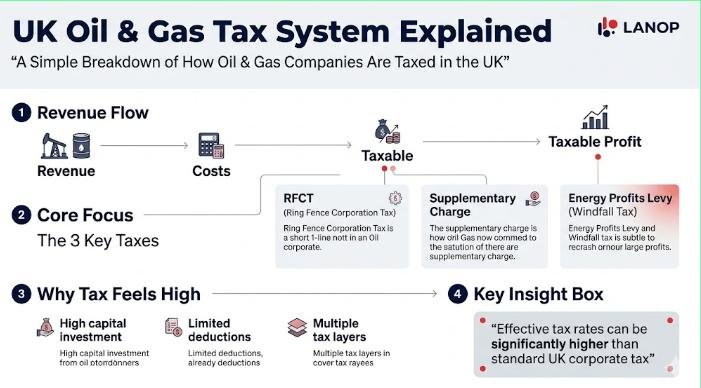
The UK’s oil and gas sector is often described as the “engine room” of the economy, but for the companies operating within it, that engine is currently under immense pressure. Between fluctuating global commodity prices and a UK tax regime that is arguably one of the most complex in the world, staying profitable isn’t just about finding oil, it’s about mastering oil and gas accounting.
If you are an operator, a service provider, or a stakeholder in the North Sea, you already know the pain points: a multi-layered tax system, “windfall” levies that shift with the political wind, and a regulatory environment that feels like it’s in a state of permanent flux. High cash flow often masks a looming tax bill that can wipe out margins if not managed with surgical precision.
This guide is designed to strip away the jargon. We will break down how the system works, explore why specialist accounting is non-negotiable, and provide actionable strategies to reduce your tax liability legally and ethically.
What is Oil and Gas Accounting? (The Foundation)
At its core, oil and gas accounting is a specialized branch of financial management that deals specifically with the unique lifecycles of exploration, development, and production. Unlike a standard retail or tech business, an oil and gas firm doesn’t just buy and sell inventory; it manages massive capital investments with long lead times and high levels of uncertainty.
Why Is It Different?
- Capital Intensity: You might spend hundreds of millions before a single barrel is produced. Accounting for these “Finding and Development” (F&D) costs requires specialized knowledge of “Full Cost” vs. “Successful Efforts” methods.
- Long Project Cycles: Decisions made in 2024 might not yield revenue until 2029. Matching costs to revenue across these cycles is a major accounting hurdle.
- Joint Ventures (JVs): Most North Sea projects are collaborative. Managing the “Joint Interest Billing” (JIB) and ensuring each partner pays their fair share of tax and operating costs is a full-time job.
- Standards: In the UK, companies typically follow UK GAAP (FRS 102) or IFRS (specifically IFRS 6 for exploration and evaluation).
How the UK Oil and Gas Tax System Works?
The UK doesn’t just tax oil companies; it places them in a “Ring Fence.” This means that the profits from oil and gas extraction in the UK and on the UK Continental Shelf (UKCS) are taxed separately from any other business activities. You cannot use losses from a side-hustle in tech to offset your oil profits.
The Three-Headed Tax Monster
To understand your tax bill, you must understand these three components:
- Ring Fence Corporation Tax (RFCT): While standard UK Corp Tax is currently 25%, the “Ring Fence” version is 30%. It applies to all upstream profits.
- Supplementary Charge (SC): On top of the RFCT, companies pay an additional 10% charge on their ring-fence profits.
- Energy Profits Levy (EPL): Commonly known as the Windfall Tax, this was introduced to capture “extraordinary” profits during the energy crisis. It currently sits at 35% (bringing the total effective tax rate on profits to a staggering 75%).
How Tax is Actually Calculated?
The “flow” of an oil and gas tax return looks like this:
Gross Revenue (Operating Costs + Allowable Capital Expenditure) = Taxable Profit.
However, the “Accounting Profit” you see in your bank account is rarely your “Taxable Profit.” HMRC has strict rules on what qualifies as an allowable cost, particularly regarding decommissioning and interest payments.
Why Tax Planning is Critical?
In an industry where the effective tax rate is 75%, a 1% error in tax planning isn’t just a rounding error, it’s a multi-million-pound drain on liquidity.
The Cash Flow Paradox: Many oil companies are “paper rich” but “cash poor.” Because tax payments often fall due before the actual cash from oil sales is realized, or because capital is tied up in long-term infrastructure, companies can face insolvency despite being highly profitable on an accrual basis. Strategic oil and gas accounting aligns your tax payments with your actual cash availability.
Proven Tax Planning Strategies
How do the major players keep their heads above water? They don’t just “pay the bill”; they plan the bill.
Capital Allowances Optimization
The UK offers generous “First-Year Allowances” (FYA) for the oil sector. Under the current EPL regime, there is an investment allowance that allows companies to offset 29% of their reinvested profits. Timing your equipment purchases to coincide with peak revenue years is the most effective way to shield income.
Loss Relief Strategies
The industry is volatile. If you incur a loss this year due to a drop in Brent Crude prices, you can “carry back” those losses to reclaim tax paid in previous, more profitable years. This is a vital tool for stabilizing cash flow.
Decommissioning Relief Planning
Eventually, every well runs dry. The costs of plugging and abandoning (P&A) wells are astronomical. However, the UK provides significant tax relief for these end-of-life costs. Setting up a Decommissioning Relief Deed (DRD) ensures that you get the tax certainty you need to fund these liabilities decades in advance.
Group Structuring
If you have multiple subsidiaries, how you allocate debt and overheads across the group can drastically change your tax profile. Utilizing group relief allows losses in one subsidiary to offset profits in another.
Expense Optimization
Distinguishing between “Repairs and Maintenance” (Revenue Expenditure) and “Enhancements” (Capital Expenditure) is a constant battle with HMRC. Proper classification can lead to immediate tax deductions rather than depreciating the cost over years.
Managing Windfall Tax (EPL) Exposure
The EPL has a built-in “Investment Allowance.” For every £1 you invest in UK extraction, you can significantly reduce your EPL liability. We help clients “spend to save” by accelerating necessary infrastructure projects.
Research & Development (R&D) Claims
Are you developing new subsea imaging technology? Or a more efficient carbon capture method? You may be eligible for R&D tax credits, which provide either a reduction in Corporation Tax or a cash payment from HMRC.
Timing of Revenue and Costs
By utilizing “Underlift” and “Overlift” accounting, managing the timing of when your share of oil is actually sold versus when it is produced you can strategically manage which tax year your revenue falls into.
Real Example: The £10M Profit Scenario
Let’s look at two hypothetical companies, both generating £10,000,000 in taxable profit before planning.
| Feature | Company A (No Planning) | Company B (Strategic Planning) |
| Total Profit | £10,000,000 | £10,000,000 |
| Capital Investment | £2,000,000 (Not optimized) | £2,000,000 (Investment Allowance) |
| Loss Carry-back | £0 | £1,000,000 (From previous year) |
| Effective Tax Rate | 75% | ~48% (Effective) |
| Total Tax Bill | £7,500,000 | £4,320,000 |
| Cash Kept in Business | £2,500,000 | £5,680,000 |
The result? Company B has £3.18 million more to reinvest, pay dividends, or weather a price drop, simply by applying expert oil and gas accounting principles.
Advanced Tax Challenges in Oil & Gas
Joint Venture (JV) Complexity
In the North Sea, you are rarely working alone. As a non-operator, you rely on the operator to provide “Cash Calls” and billing statements. Errors here are common. If an operator misclassifies an expense, your tax return is wrong. We provide JV auditing to ensure your partners aren’t inadvertently increasing your tax burden.
Cross-Border Taxation
Many UK firms operate in Norway, the US, or Africa. Navigating Double Taxation Treaties is essential to ensure you aren’t paying tax on the same barrel of oil twice. Furthermore, managing the “Permanent Establishment” rules is critical for contractors working offshore in various jurisdictions.
Managing Liquidity
Tax is often due before the physical oil has reached the refinery. We help firms implement “Tax Smoothing” techniques and secure financing backed by future tax rebates (like R&D or Decommissioning credits).
Common Tax Mistakes (And What Triggers HMRC Audits)
HMRC views the oil and gas sector as a high-yield target for audits. Common mistakes that trigger “discovery assessments” include:
- Misclassifying OpEx as CapEx: Trying to claim an immediate deduction for what should be a long-term asset.
- Missing the “Ring Fence” boundary: Accidentally including non-oil activities in your RFCT return.
- Inadequate Documentation for JVs: Failing to provide the granular evidence required for joint interest billing.
- Neglecting the Energy Profits Levy: Assuming the windfall tax doesn’t apply because your company is “small” (there is no “small company” exemption for the EPL).
Oil & Gas vs. General Accounting
Why can’t your local high-street accountant handle your oil firm?
- The Scale of Numbers: General accountants are used to thousands; we are used to millions.
- The Regulatory Pressure: General accounting doesn’t deal with the North Sea Transition Authority (NSTA) or specific environmental levies.
- The Specificity: A general accountant won’t know the difference between “Successful Efforts” and “Full Cost” accounting, a mistake that could cost you your entire investment profile.
Future Trends: The Energy Transition
The shift toward Net Zero is changing the face of oil and gas accounting. We are seeing:
- Carbon Taxes: New levies on emissions.
- Stranded Assets: Having to write down the value of reserves that may never be extracted.
- Renewable Integration: Firms pivoting to wind or hydrogen need to know when their “Ring Fence” protection ends and standard tax rules begin.
Proactive planning is the only way to survive this transition.
How Lanop Business and Tax Advisors Help?
Navigating the North Sea’s financial waters requires a navigator who knows the reefs. At Lanop Business and Tax Advisors, we don’t just file your returns; we build your financial fortress.
- Bespoke Tax Strategy: We analyze your exploration and production cycle to minimize EPL and RFCT exposure.
- Capital Allowance Maximization: We ensure every bolt, pipe, and platform is depreciated in the most tax-efficient way possible.
- Cross-Border Expertise: Whether you’re based in Aberdeen but drilling in the Gulf, we manage your global tax footprint.
- Real-Time Advisory: Don’t wait until the end of the year to find out you owe millions. We provide monthly “Tax Exposure” reports.
Don’t let the complexity of oil and gas accounting drain your reserves. Let Lanop turn your tax department into a value center.
Key Takeaways
- The 75% Reality: Between RFCT, SC, and EPL, the UK tax rate is high, making planning a survival necessity.
- Investment is Your Friend: Use the EPL Investment Allowance to shield profits by reinvesting in your infrastructure.
- Specialization Matters: The “Ring Fence” creates a unique world where standard accounting rules don’t always apply.
Frequently Asked Questions
What are the main taxes UK oil and gas companies need to plan for?
UK oil and gas companies face a unique tax regime including Corporation Tax (currently 25%), Petroleum Revenue Tax (PRT) for older fields, and the Energy Profits Levy (EPL) an additional 35% windfall tax on extraordinary profits introduced in 2022. Combined, the marginal tax rate can reach 75%–78% on North Sea oil and gas production. Effective tax planning across capital allowances, investment reliefs, and allowable deductions is critical to minimize liabilities while remaining compliant with HMRC and industry-specific regulations.
How do capital allowances work specifically for oil and gas extraction activities?
Oil and gas companies can claim 100% first-year capital allowances on qualifying expenditure including drilling equipment, platforms, pipelines, and extraction infrastructure under the super-deduction scheme (for qualifying periods). Decommissioning costs also qualify for tax relief when incurred. Proper classification of capital vs operational expenditure and timing of claims significantly impacts cash flow and tax positions. Specialist advisors ensure maximum allowances are claimed while meeting stringent HMRC reporting requirements for extractive industries.
What is the Energy Profits Levy and how does it affect tax planning?
The Energy Profits Levy (EPL) is a 35% windfall tax on extraordinary profits from UK oil and gas extraction, effective from May 2022 and extended through March 2028. Combined with standard Corporation Tax (25%) and sometimes Petroleum Revenue Tax, the total tax rate can exceed 75%. However, EPL includes an 80% investment allowance for qualifying capital expenditure, incentivizing reinvestment in UK production. Tax planning focuses on maximizing investment allowances and structuring expenditure to minimize EPL impact.
How should oil and gas companies handle decommissioning cost provisions for tax purposes?
Decommissioning costs for retiring oil and gas assets are tax-deductible when actually incurred, not when provisioned. Companies must forecast decommissioning expenses decades in advance for financial reporting but cannot claim tax relief until payments are made. Tax planning involves timing decommissioning work to align with profitable periods, utilizing decommissioning relief agreements with HMRC, and structuring group arrangements to optimize tax relief across entities. Poor planning leaves companies with large decommissioning bills and insufficient tax relief to offset costs.
What tax considerations apply when investing in UK renewable energy transition projects?
Many UK oil and gas companies are diversifying into offshore wind, hydrogen, and carbon capture projects which have different tax treatments. Renewable energy projects may qualify for different capital allowances, green investment incentives, and R&D tax credits not available for fossil fuel extraction. Tax planning requires structuring these activities in separate entities or divisions to optimize reliefs while avoiding contamination of oil and gas tax positions. Specialist advisors help navigate the transition from high-tax extraction to potentially lower-tax renewable operations.
Conclusion
Tax planning for UK oil & gas companies is not just about staying compliant.it’s about protecting profits in a complex and high-risk environment. With multiple taxes, volatile revenues, and significant capital investment, a proactive strategy can make a real difference in reducing liabilities and improving cash flow.
By understanding the system and applying the right planning techniques such as optimising allowances, managing losses, and structuring operations effectively businesses can turn tax from a burden into a strategic advantage.
Lanop Business and Tax Advisors provide the specialist expertise needed to navigate this complexity, helping oil & gas companies stay compliant while maximising tax efficiency. In a challenging industry, smart tax planning is what sets successful businesses apart.


Printing Solutions South Africa and Restaurant Menu Lightboxes for Business Growth

Why Most Buyers Don’t Choose the Best Property, They Choose the Most Comfortable one

6 Benefits of Community-Based Senior Living

Common Causes of Knee Pain and Effective Ways to Manage Naturally and Medically

Make1M.com: Unlock the Path to Lasting Financial Freedom

Noah Fearnley Net Worth: Age, Career, Girlfriend, Bio, Net Worth 2025 And More
-
 Health7 months ago
Common Causes of Knee Pain and Effective Ways to Manage Naturally and Medically
-
 Blog12 months ago
Make1M.com: Unlock the Path to Lasting Financial Freedom
-
 Celebrity1 year ago
Noah Fearnley Net Worth: Age, Career, Girlfriend, Bio, Net Worth 2025 And More
-

 Business10 months ago
Pipedrive CRM Integrations: Sales Tools That Improve Deal Management
-

 Business1 year ago
PO Box 6887 Coventry: What’s Really Behind the Address?
-

 Celebrity1 year ago
Eric Haze Net Worth: Feet, Age, Net Worth 2025, and Family – Everything You Need to Know
-

 Celebrity2 years ago
Who Is Zoe Bearse: All About The Life Of Amanda Bearse’s Daughter
-

 Business9 months ago
Why Fairy-Tale Themes Continue to Inspire Modern Digital Games